Managed services vs IT support: Which IT solution is right for your business?
Businesses strongly rely on IT infrastructures to communicate, manage data, operate cloud applications, provide security, and conduct other business activities. In case of any problem in all these processes, the availability of an appropriate support level will be a matter of whether the situation can be quickly resolved or not. This is why it is crucial to know the concept of managed services vs IT support before you choose which one for your organisation.
Though there are some similarities between these two service models, they differ in approach to dealing with the IT issues, payment model, and responsibility levels.
What are managed IT services?
Managed IT services refer to an IT support service provided by an external provider who is responsible for managing and monitoring an organisation’s IT infrastructure. It does not wait until there is a problem in the IT infrastructure before dealing with it.
Depending on the service agreement, the managed services could include, among other things, network management, security, cloud services, backup services, user support, and maintenance of the systems. SLA can also stipulate the expected response time from the service provider.
It is particularly helpful to those organisations that require consistent IT management without having a big internal IT department.
What is traditional IT support?
Traditional IT support typically involves a break/fix approach. If there are any issues within an organisation’s system, the organisation will call the IT support company, which will look into the matter and fix whatever the problem may be.
This approach works well with organisations whose IT environment is quite basic and does not have many problems. In addition, this is flexible because businesses only have to pay when they need help instead of subscribing to a monthly package.
But generally, the approach addresses specific issues rather than managing the entire environment.
Comparison of Managed services and IT support services
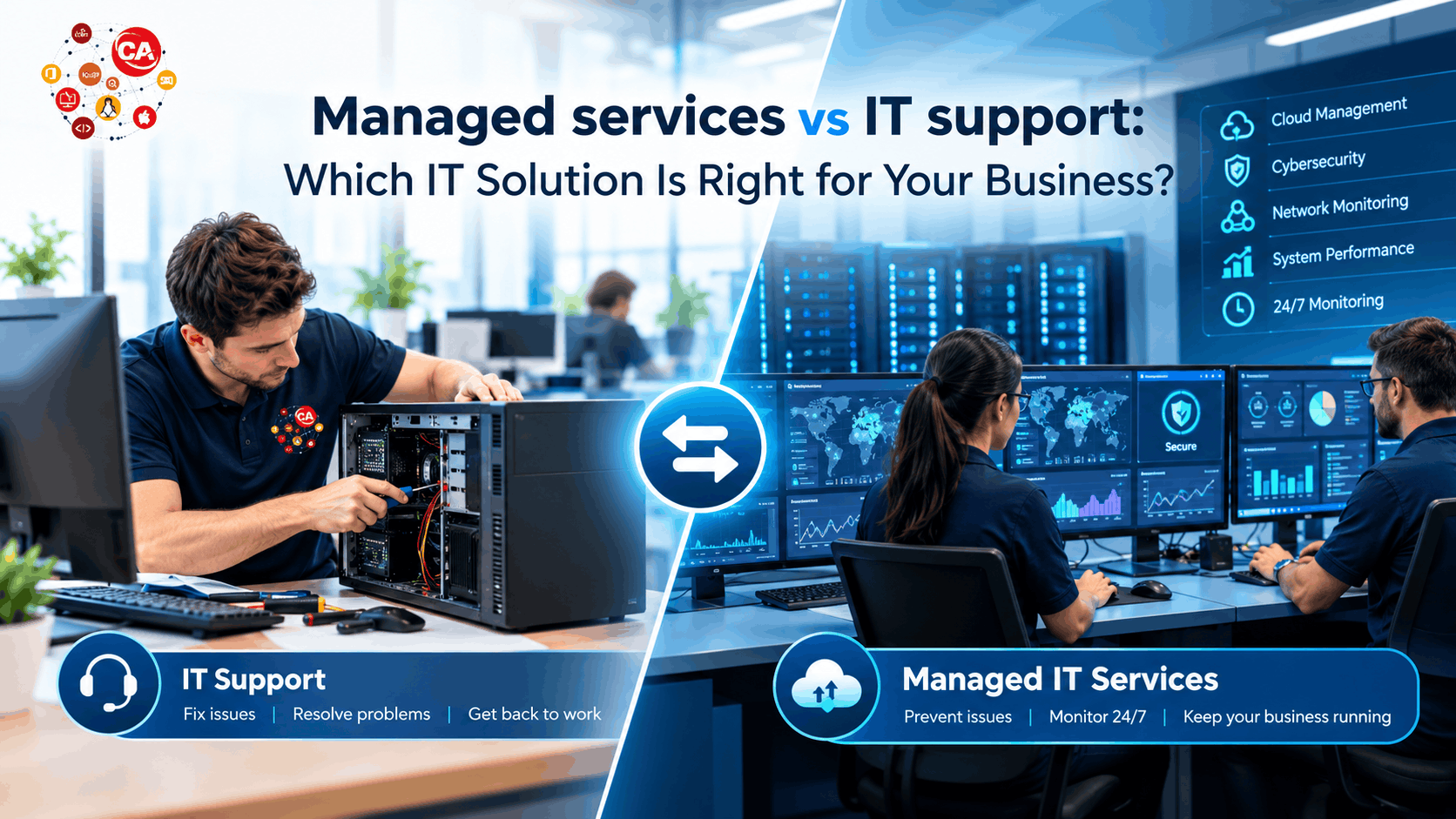
The most important difference between managed services and IT support services is that of proactive management versus reactive troubleshooting.
In the case of managed services, systems may be constantly monitored. Possible malfunctions, suspicious activity, and the necessity of maintenance may be noticed before they lead to serious operational issues. The usual procedure of IT support starts when a user or company notices a problem.
The other difference is related to pricing. Managed services are usually offered on a regular monthly basis, while IT support is priced either by the hour or incidentally.
Scope is another area where there is a clear difference. Managed services look at the larger picture when it comes to the use of technology within an organisation, while traditional IT support tends to be problem-specific.
Advantages of Managed IT Services and Traditional IT Support
| Advantages of Managed IT Services | Advantages of Traditional IT Support |
|---|---|
| Proactive monitoring: The systems can be monitored consistently to detect any problem before it becomes an actual problem. | Flexible support: Companies can get technical help for any particular IT problem without signing up for a full-scale management service. |
| Predictable costs: The predictable monthly fee structure can help with budgeting IT costs. | Buy only what you require: Organisations experiencing fewer issues within their IT departments may prefer services on the basis of incidents/timing. |
| Security management that continues throughout: Patching, control and monitoring can help lower the risk of vulnerability. | Suitable for an easy environment: Classic IT support works for firms that have an easy network environment. |
| Availability of expertise: Companies will have access to greater technical expertise without having a big IT team in-house. | Reduced long-term commitment: Companies that don’t need constant oversight would like to deal with IT companies only when they need specific expertise. |
| Scalability of IT management: The service can be customised to accommodate growth in users, devices, applications and infrastructure. | Helpful when there are rare instances of technical problems: The service can assist in resolving hardware and software problems as well as other such instances. |
Which IT approach is best for your company?
This will depend on your infrastructure, finances, security requirements, and growth plans. Managed services tend to suit companies whose operations are heavily dependent on their IT, who encounter frequent technical difficulties, need monitoring, and/or need help with cybersecurity, cloud computing and technology strategy.
Traditional IT support might work just fine for companies where there aren’t many complex technical needs and there are infrequent problems.
For organisations that already have an internal IT team, the organisation may also utilise an external service to increase the range of services offered by the existing IT team. It would also have the benefit of more expertise in specific areas such as cybersecurity and cloud computing.
Managed Service Provider can thus act as an extension of an existing IT department or offer an outsourced IT facility altogether, depending upon the needs of the business.
FAQs
1. What would be the cost of IT management support in the UK?
This will vary based on the number of users or devices, the complexity of the IT systems, and also the type of service to be offered. The IT management support services tend to be charged per month on a fixed fee basis.
2. Does cybersecurity form part of the managed IT services?
Yes. Any good managed service provider ought to be able to provide some form of security such as endpoint security, email security, patch management, two-factor authentication and security monitoring, among others.
3. Is it possible for managed IT support to coexist with an internal IT department?
Yes, this is feasible because managed service providers can help out internal IT departments through expert assistance. This type of co-managed model is valuable when an organisation’s IT landscape becomes increasingly complicated.
4. What are some signs that my company may need managed IT services?
Some of the signs include IT disruptions being commonplace at your business, high reliance on IT, and no IT department within the organisation. Management of IT services may also be required when there is difficulty managing problems in the areas of cybersecurity, back-ups, and IT management.
Get Managed IT service in Oxford
Choosing the right model of IT support will ensure that efficiency, security, and reliability are achieved. Should you require an IT support service that involves monitoring and expertise in IT, then Managed IT Service Oxford from Wiseserve is what you need!