
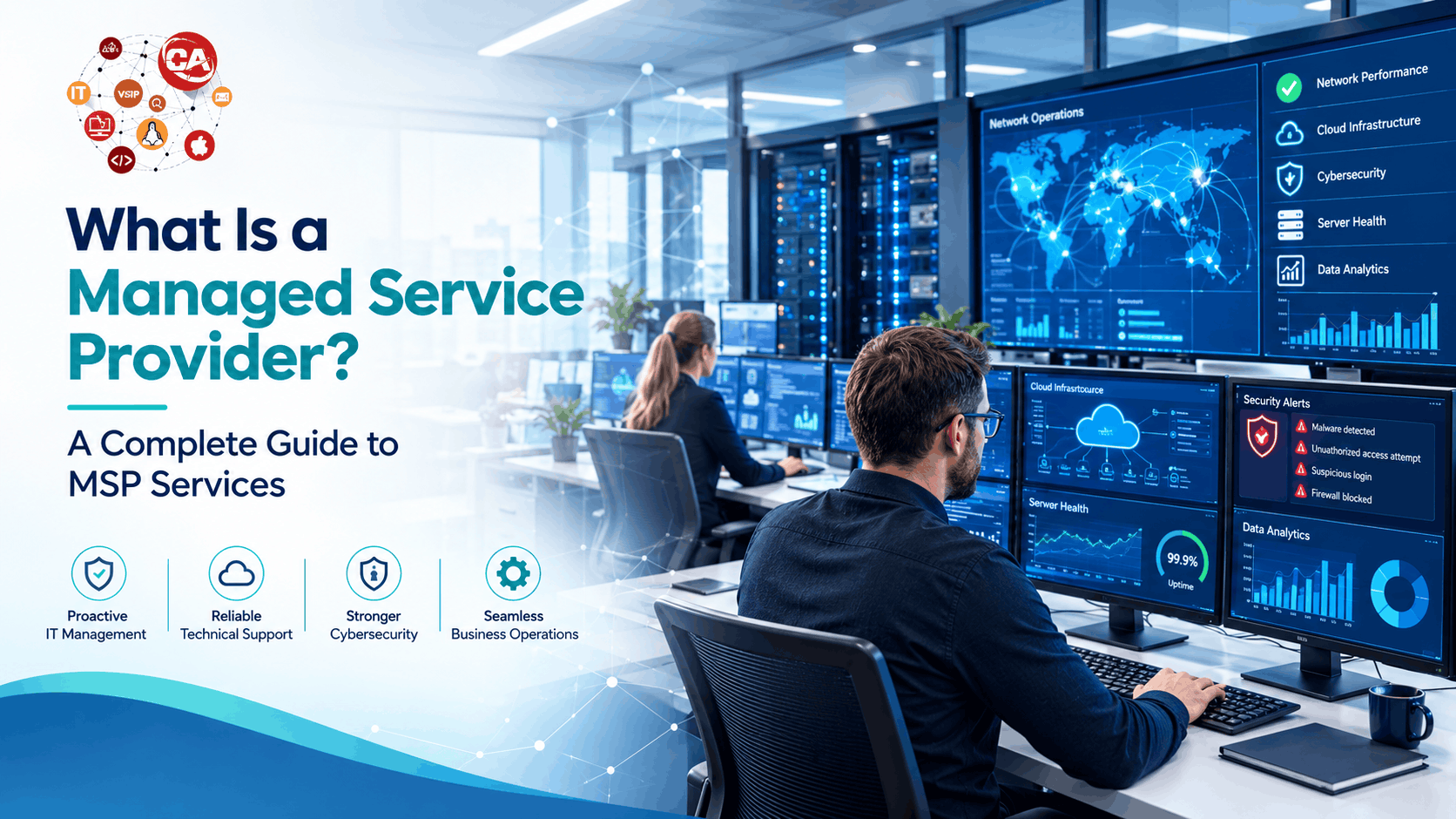
What Is a Managed Service Provider? A Complete Guide to MSP Services
Modern businesses use IT systems for communication, storage, applications, security, etc. However, managing such systems requires technical knowledge and skills, which may be lacking within an organisation. That is when an MSP can assist.
Managed Service Provider (MSP) is a vendor that provides remote monitoring and management of IT infrastructure, IT networks, IT systems, applications, etc. Unlike regular IT services, MSP does not just fix the issue but monitors and maintains an organisation’s system proactively.
What Are the Functions of a Managed Service Provider?
The functions of an MSP involve handling specified aspects of the IT network of the enterprise. These are determined by the needs and existing systems of the enterprise itself.
MSP usually provides the following set of services: remote IT management, constant monitoring, proactive maintenance, software updates, technical support, help desk support, data backup, and disaster recovery. They can also offer cybersecurity solutions, IT strategy development, and technical training for employees.
Some of the distinctions between the two include the proactive approach that MSPs take. This means that instead of waiting for an event to occur and cause problems to business processes and employees, MSPs use monitoring tools to identify such events and prevent them from becoming serious.
Another distinction is that those businesses that cannot afford a team of in-house IT experts can benefit from the specialised knowledge that MSPs offer without having to hire and train their own team.
Types of Managed Service Providers
There are various Types of Managed Service Providers, where some of them have specialisation in certain areas within IT. It is important to select the appropriate one according to the system requirements.
1. Managed Network Service Provider
The managed network service provider pays attention to such issues as network performance, availability and security. These services may consist of monitoring of bandwidth and availability, configuration of networks, management of firewalls and remote secure access, and security updates for the network devices.
Network management is especially essential for businesses that use cloud computing and have hybrid workplaces and many business locations. Monitoring allows the timely discovery of potential connectivity problems.
2. Cloud Managed Service Provider
Cloud MSPs are providers who have the expertise to manage cloud computing environments, which consist of public, private, and hybrid clouds. They have duties such as cloud migration, cloud configuration, identity and access management, cloud backup, cloud scaling, and cloud security, among others.
Cloud MSPs can assist organisations in optimising cloud costs and enhancing cloud infrastructure performance.
3. Managed Security Service Provider
A managed security service provider (MSSP) is a business that offers cybersecurity management services in particular. In contrast to the general MSP offering security along with other services, an MSSP is mainly involved with aspects such as threat detection, vulnerability management, identity security, and incident response.
Thus, companies have a choice of getting either comprehensive IT management with the help of an MSP or having some extra security management from an MSSP.
Why would companies use MSPs?
One of the reasons why firms may decide to use MSPs is a lack of internal IT skills, or the fact that there might be a necessity for additional skills that could be used together with the existing IT department. Another flexibility is that using an MSP company may be scaled according to the growth of the organisation.
Access to specialists and advanced IT technologies is another major advantage of using MSPs since it would save companies’ time and increase the efficiency of operations.
Furthermore, managed services can provide continuity for business through continuous monitoring, maintenance, backup of data, and disaster recovery solutions. Proactive management could minimise the risk of unpreventable downtime and help organisations deal with problems more efficiently.
When evaluating Managed services vs IT support, it is important to note that an MSP could offer much wider management options rather than addressing only technical problems.
What are the benefits of using an MSP?
There could be some benefits of using managed services in this manner:
Manageable costs: IT costs and budgets become more manageable through a managed service contract.
Knowledge experts: An organisation does not require a large group of IT personnel to obtain all the technical information.
Maintenance services: Monitoring is useful to avoid significant issues due to proactive maintenance.
Flexible services: Services provided by MSPs are flexible and can be changed as per the requirement.
Safety: Security monitoring and vulnerability testing can be provided by the MSPs.
Protection of the business: Backup and disaster recovery services can be provided by the MSPs.
Efficiency: A properly working IT system will increase the productivity of the employees.
MSP and Its Operations Within the Organisation
Generally, the process is initiated by looking at the existing IT infrastructure, systems, security posture, and requirements of the business. The goal is to establish any gaps and find out what services are needed.
Thereafter, the service-level agreement (SLA) will specify the type of services that the company provides, the cost, response time, security responsibilities, etc. When the process of providing services starts, the MSP keeps an eye on the IT infrastructure of the company and talks to the company regarding the issues.
Such an approach will ensure that IT management remains relevant to shifting business needs, and does not become a one-time technological activity.
FAQs
1. What is MSP?
MSP stands for Managed Service Provider. It is a term used to describe a third-party entity providing managed, IT-related services to an enterprise.
2. Does IT support and MSP mean the same thing?
No, they don’t. While traditional IT support might be concentrated on handling any issues that arise, an MSP is responsible for management and monitoring services, among others.
3. Does an MSP offer cybersecurity services?
Yes. It is common for many MSPs to incorporate cybersecurity into their services. Such services could be anything from security audits to threat monitoring and prevention measures, among others.
Managed IT Services for Your Business
In order to ensure that the modern company is running smoothly and effectively, it requires reliable IT systems. Cooperation with a reliable managed service provider will allow you to have continuous monitoring and maintenance of your systems provided by professionals.
If your company requires reliable IT management services, explore the range of managed IT solutions in Oxford offered by Wiseserve.